Northern Virginia Property Management Best Practices
Northern Virginia Property Management Best Practices
Effective tenant screening in Northern Virginia requires strict adherence to local rental laws, including Fairfax and Loudoun County regulations. Landlords must verify income, rental history, and criminal records thoroughly. Even thorough checks can miss bad tenants due to incomplete records. A professional property manager mitigates these risks, protecting investment returns.
Key Takeaways
- Northern Virginia tenant screening requires strict adherence to Fairfax and Loudoun County regulations.
- Written tenant screening criteria eliminate subjectivity and ensure consistent, objective applicant evaluation.
- A signed authorization transforms the application into a verifiable record and is non-negotiable.
- Documented consistency provides the strongest defense against fair housing complaints.
What Are the Legal Foundations for Screening in Northern Virginia?
Northern Virginia tenant screening rests on federal anti-discrimination statutes and the Virginia Residential Landlord and Tenant Act, alongside county-level regulations in Fairfax and Loudoun.
What Laws Govern Tenant Screening in Northern Virginia?
The Virginia Residential Landlord and Tenant Act establishes the statutory foundation for all rental relationships across the Commonwealth. This legislation defines permissible screening practices, application fee limits, and disclosure requirements. Federal law adds another critical layer. The Fair Housing Act prohibits discrimination based on race, color, national origin, religion, sex, familial status, and disability. Violations carry substantial financial penalties and potential civil liability.
How Should Landlords Establish Objective Screening Criteria?
Written criteria eliminate subjectivity from the evaluation process. Establishing clear, written tenant screening criteria before accepting applications ensures every applicant is evaluated using consistent and objective standards. These criteria should focus on an applicant’s ability to meet lease obligations rather than personal impressions or characteristics unrelated to the tenancy.
A prudent approach follows this sequence:
- Draft a written screening policy specifying minimum income ratios, credit score thresholds, and rental history requirements.
- Provide the policy to every applicant before accepting any application fee.
- Apply the identical criteria to all applicants without exception or improvisation.
- Document the rationale for every approval or denial decision in writing.
Northern virginia property management professionals consistently emphasize that documented consistency provides the strongest defense against fair housing complaints. Tenant screening nova practices that deviate from written standards invite regulatory scrutiny. Landlord property management va firms routinely advise clients that objective criteria protect both the investment and the owner’s legal standing. Homes365 by Eunice Johnson is located in Sterling, VA, US.

How Do You Prepare a Compliant Rental Application?
A compliant rental application begins with a complete, standardized form that collects employment history, income, previous rental addresses, and personal references. Northern Virginia landlords who skip this foundational step expose their rental portfolios to avoidable vacancy losses and legal disputes.
Tenant screening nova standards demand consistency across every applicant. A single application format, used without variation, protects landlords from Fair Housing Act violations and Virginia's tenant-screening regulations. Inconsistent forms invite discrimination claims that erode both revenue and reputation.
What Documents Must a Rental Application Include?
The application must capture four categories of information, each serving a distinct verification purpose.
- Employment history establishes income stability and job tenure.
- Income documentation confirms the applicant can sustain monthly rent obligations.
- Previous rental addresses reveal payment patterns and property care history.
- Personal references provide third-party insight into character and reliability.
Why Is Written Authorization Essential?
Every applicant must sign an authorization permitting the landlord to verify the information provided. Without this signed consent, landlords cannot legally contact employers, former landlords, or reference contacts. Skipping this step leaves the screening process incomplete and the property exposed to unverified applicants.
Landlord property management va professionals treat the signed authorization as non-negotiable. The authorization transforms the application from a self-reported document into a verifiable record. Northern Virginia landlords who accept unsigned applications forfeit the right to confirm critical details before lease signing.
Northern virginia property management best practice pairs the consistent form with the signed authorization. Together, these two elements create a defensible screening foundation. Landlords who standardize both components reduce legal exposure while improving tenant quality across every rental unit.
What Income and Employment Verification Is Required?

Income and employment verification confirms a prospective tenant can comfortably afford the rent, and a solid income verification process protects the rental investment from payment defaults and costly turnover. Northern Virginia landlords must review income, credit, rental history, references, and relevant background information carefully, since questionable or inconsistent details require verification before any leasing decision.
What Documents Prove Income for Tenant Screening?
Landlords should request documentation that substantiates stated earnings, including pay stubs, W-2 forms, tax returns, and employer verification letters. Bank statements offer supplementary evidence of financial stability, while self-employed applicants may provide profit-and-loss statements or 1099 forms.
How Does Employment Verification Work?
Employment verification confirms the applicant holds the position and salary claimed on the application, typically through a direct call to the employer's human resources department. Written verification from the employer provides a documented record, and landlords should compare employer-provided figures against the applicant's stated income.
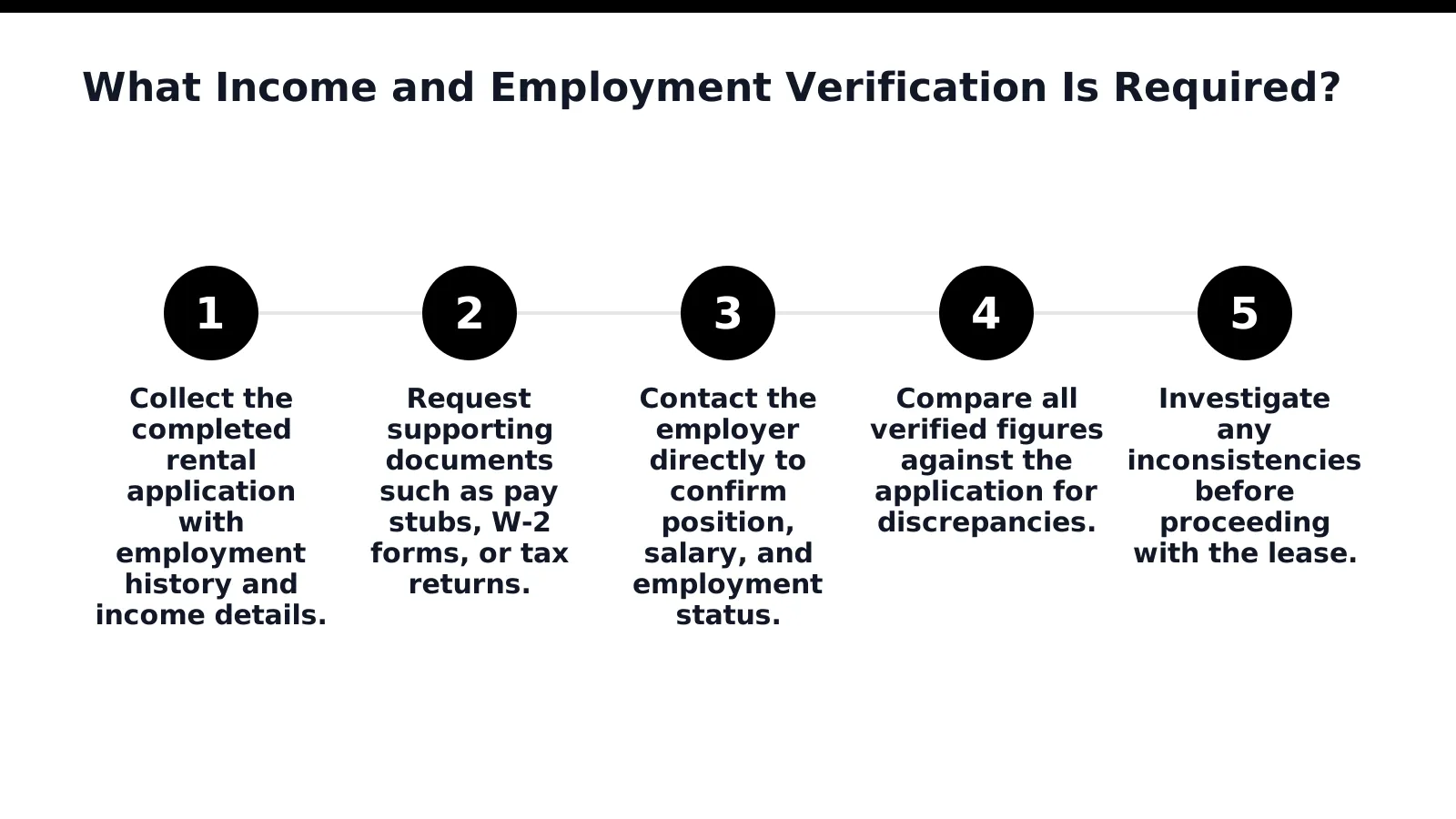
The verification process follows a clear sequence:
- Collect the completed rental application with employment history and income details.
- Request supporting documents such as pay stubs, W-2 forms, or tax returns.
- Contact the employer directly to confirm position, salary, and employment status.
- Compare all verified figures against the application for discrepancies.
- Investigate any inconsistencies before proceeding with the lease.
Tenant screening nova standards demand this level of diligence. Northern virginia property management professionals apply these steps consistently across every applicant. Landlord property management va practices treat income verification as non-negotiable.
A thorough review of income and employment documentation reduces the risk of late payments and eviction proceedings. Landlords who skip verification steps expose their properties to financial loss.
How Do You Conduct a Thorough Background and Credit Check?

A thorough background and credit check verifies an applicant’s financial responsibility and personal history through multiple independent data sources. Northern Virginia landlords who rely on a single report or incomplete verification expose their investments to tenants with hidden evictions, undisclosed debt, or fabricated rental histories.
Even with thorough background checks, bad tenants slip through screening in Northern Virginia. Incomplete records, misleading information, and gaps in rental history verification create vulnerabilities that standard reports miss. Overlooked criminal records or incomplete references transform seemingly qualified applicants into costly headaches for property owners. A disciplined, multi-step verification process closes these gaps.
What Documents Must an Applicant Provide Before Screening Begins?
Every applicant submits a signed rental application, government-issued photo identification, and recent pay stubs or tax returns covering at least two years. The application authorizes credit pulls, criminal background checks, and direct contact with previous landlords. Without signed authorization, no screening proceeds.
How Does a Landlord Verify Rental History Beyond the Application?
Contacting prior landlords directly remains the most revealing step. Property owners call the management office or landlord listed on the application rather than a personal reference the applicant provides. They ask specific questions about payment timeliness, lease violations, and property condition at move-out. Gaps in rental history demand written explanation and supporting documentation.
- Pull a full credit report from a major bureau. The report reveals payment patterns, outstanding debts, and prior evictions. A score below 620 signals elevated risk in Northern Virginia’s competitive rental market.
- Run a national criminal background check. This search spans county, state, and federal databases. It uncovers convictions that applicants omit from self-disclosures.
- Verify employment and income directly. Contact the employer’s human resources department to confirm position, salary, and tenure. Require income documentation showing monthly rent does not exceed 30 percent of gross household income.
- Cross-check eviction history through court records. Many evictions never appear on credit reports. Searching local court databases in Fairfax County, Loudoun County, and surrounding jurisdictions catches filings that other checks miss.
- Interview at least two prior landlords. Ask whether the applicant paid on time, caused property damage, or received lease violation notices. Written records from a northern virginia property management firm carry more weight than verbal assurances from a private owner.
Why Do Standard Screening Reports Sometimes Miss Critical Information?
Standard reports pull from databases with reporting lags and jurisdictional gaps. A tenant screening nova process that stops at a basic credit check misses evictions filed in courts that do not report to national bureaus. Criminal records from certain counties appear only in local databases. Landlord property management va professionals supplement automated reports with manual court searches and direct reference calls. This layered approach catches what automated systems overlook.
Homes365 by Eunice Johnson applies these verification standards to every applicant, protecting Northern Virginia property owners from the financial damage of a misplaced tenancy.
How Do You Verify Rental History and References?

Verification of rental history and references demands direct contact with previous landlords and a systematic review of documented tenancy records. A thorough process uncovers patterns that application forms alone conceal, protecting Northern Virginia property owners from costly placement errors.
What Questions Should Landlords Ask Previous Property Owners?
Inquiries must extend beyond simple confirmation of tenancy dates. Previous property owners provide critical insight into payment consistency, property condition upon departure, and adherence to lease terms. Gaps in rental history often signal periods of eviction, unauthorized occupancy, or financial instability that applicants prefer to omit. Incomplete references raise similar concerns, as they frequently indicate a deliberate effort to obscure problematic tenancies from a prospective landlord's review.
How Can Landlords Detect Fabricated Rental Histories?
Fabricated histories collapse under methodical scrutiny. Cross-reference the telephone numbers provided on the application with public property ownership records rather than calling the number listed without verification. A fraudulent reference often connects to a friend or family member posing as a prior landlord. Property owners who manage their own northern virginia property management responsibilities benefit from contacting at least two previous landlords, not merely the most recent one. The applicant's current landlord holds motivation to facilitate a departure, making the prior landlord's candid assessment far more valuable.
Tenant screening nova professionals recommend the following verification sequence:
- Confirm the applicant's identity through government-issued identification before initiating any reference checks.
- Obtain signed authorization permitting contact with all listed references and previous property owners.
- Verify each previous address against county tax assessor databases to confirm the named landlord actually owns the property.
- Contact two prior landlords, asking identical questions about payment timeliness, lease compliance, and property care.
- Document every response in writing, noting any hesitation, vagueness, or inconsistency that warrants further investigation.
Landlord property management va standards require this level of diligence because the financial consequences of a poor placement compound rapidly. Eviction proceedings in Northern Virginia jurisdictions consume months of lost rent and thousands in legal fees. A single overlooked gap in rental history transforms a seemingly qualified applicant into a protracted liability. Methodical verification protects the asset and preserves the investment's long-term performance.
What Are the Best Practices for Managing Tenants in Northern Virginia?

Effective tenant management in Northern Virginia begins with rigorous screening. Proper tenant screening mitigates risks and ensures that an investment remains profitable and hassle-free. Finding the right tenant is one of the most important steps in protecting an investment property.
A thorough screening process minimizes the risk of late payments or property damage. It also helps ensure a stable, positive landlord-tenant relationship. Landlords who skip verification steps often face costly turnover and extended vacancies.
What Documents Should a Northern Virginia Landlord Require?
A complete rental application forms the foundation of sound northern virginia property management. The application must include employment history, income verification, previous rental addresses, and personal references. Every applicant should sign an authorization allowing the landlord to verify the information provided. Incomplete applications signal risk and warrant immediate rejection.
How Does Tenant Screening Protect a Rental Investment?
Tenant screening nova practices serve as the primary defense against financial loss. A detailed background check uncovers prior evictions, criminal history, and credit irregularities that applicants may omit. Verifying income and employment confirms the tenant's capacity to meet monthly obligations. Landlords who conduct consistent, documented screening for every applicant reduce fair housing complaints and strengthen their legal position.
Professional landlord property management va extends beyond the lease signing. Regular property inspections, prompt maintenance responses, and clear communication channels preserve asset value and tenant satisfaction. Documenting all interactions creates a defensible record should disputes arise. The most successful Northern Virginia investors treat tenant relations as an ongoing professional obligation rather than a transactional necessity.
How Do You Handle Lease Renewals and Evictions Legally?
Lease renewals and evictions in Northern Virginia follow strict legal protocols. Landlords must navigate both processes with precise documentation and unwavering compliance with local tenant-landlord laws.
What Legal Framework Governs Lease Renewals in Northern Virginia?
Northern Virginia enforces specific tenant-landlord laws designed to protect both parties. The Fair Housing Act prohibits discriminatory renewal practices, while local regulations add further requirements. Landlords must provide written renewal offers within the notice period specified by the lease agreement, typically 30 to 60 days before expiration. Any rent increase must comply with Virginia's statutory notice requirements and cannot be retaliatory or discriminatory in nature.
How Should Landlords Approach the Eviction Process?
Eviction demands meticulous adherence to Virginia's unlawful detainer process. The procedure follows a clear sequence:
- Serve a written notice to cure or vacate, specifying the lease violation and the statutory cure period.
- File an unlawful detainer action with the General District Court if the tenant fails to remedy the breach.
- Obtain a court-issued writ of possession before any physical removal occurs.
- Schedule the eviction with the sheriff's department, never through self-help measures.
Self-help evictions, including lockouts or utility shutoffs, violate Virginia law and expose landlords to significant liability. Every step requires proper service of process and court approval.
What Documentation Protects Landlords During These Processes?
Comprehensive records form the foundation of legal protection. Maintain copies of all correspondence, signed lease agreements, renewal notices, and court filings. Photographic evidence of property condition proves invaluable during eviction proceedings. For northern virginia property management professionals, this documentation demonstrates compliance with landlord property management va regulations and supports tenant screening nova decisions that preceded the tenancy. Without meticulous records, even justified evictions face dismissal in court.
What Common Mistakes Should Northern Virginia Landlords Avoid?

Northern Virginia landlords undermine their own screening processes by trusting incomplete applications and unverified references. A single overlooked gap in rental history or an unconfirmed employment record transforms a seemingly qualified applicant into a costly liability. Even thorough background checks fail when landlords skip critical verification steps.
Why Do Bad Tenants Pass Screening in Northern Virginia?
Incomplete records, misleading information, and gaps in rental history verification allow problematic tenants to slip through even rigorous screening protocols. Overlooked criminal records or incomplete references turn apparently qualified applicants into expensive headaches for property owners. The fast-growing Northern Virginia rental market compounds this risk, as landlords rush to fill vacancies and bypass essential checks.
What Verification Steps Do Landlords Most Often Skip?
Three verification failures consistently produce tenant problems for Northern Virginia property owners:
- Confirm every previous landlord reference directly. Contact prior property managers by phone rather than accepting written references at face value. Written letters conceal eviction histories and property damage records that a brief conversation reveals.
- Verify employment and income with current employers. Request pay stubs and then call the employer to confirm the documents are genuine. Fabricated income statements appear convincing but collapse under direct verification.
- Run comprehensive criminal background checks across all jurisdictions. A single-county search misses offenses committed in neighboring jurisdictions. Northern Virginia's proximity to Washington, D.C. and Maryland demands multi-state screening for complete tenant screening nova results.
Landlords who skip these steps carry the unrecovered costs of evictions, property damage, and extended vacancies. Professional northern virginia property management services close these gaps through systematic verification protocols. Landlord property management va expertise protects investment returns by catching the discrepancies that independent owners miss.
FAQ
What laws govern tenant screening in Northern Virginia?
The Virginia Residential Landlord and Tenant Act and the federal Fair Housing Act establish the legal framework, prohibiting discrimination and defining permissible screening practices.
How do I establish objective screening criteria for applicants?
Draft a written screening policy specifying minimum income ratios, credit score thresholds, and rental history requirements, then apply the identical criteria to every applicant.
What should a compliant rental application include?
A compliant application collects employment history, income, previous rental addresses, and personal references on a complete, standardized form.
Conclusion
The discerning Northern Virginia landlord who integrates rigorous tenant screening with meticulous legal compliance transforms property management from a reactive burden into a curated investment strategy, ensuring each tenancy reflects the same standard of excellence as the property itself.
About The Author
Eunice Johnson is a seasoned real estate professional and lead agent at Homes365, specializing in Northern Virginia residential sales. With over a decade of experience, Eunice combines deep local market knowledge with a client focused approach to help buyers and sellers achieve strong, lasting results. She works closely with first-time buyers to build realistic plans and secure appropriate financing, while guiding sellers through every stage of the process, from preparation to closing, for a smooth and successful transaction. Eunice is a trusted resource for first-time buyers and sellers alike, offering insight into local programs, financing options, and strategic marketing techniques.
For Northern Virginia property owners seeking hands-on support with tenant screening and the daily demands of a rental portfolio, Homes365's property management services extend this same client-focused standard of care across Loudoun and Fairfax County.
Phone: +1 (571) 261-7400 Email: [email protected]
Contact Us
Northern Virginia property owners ready to discuss tenant screening, leasing, or full-service property management can reach Homes365 directly, serving Sterling, VA and surrounding areas.
- 📞 Phone: (571) 261-7400
- ✉️ Email: [email protected]
- 📅 Consultation: Schedule time with Eunice
- 🏠 Schedule a tour of a managed property by booking time with Eunice.
- 💻 Request a virtual visit for a remote walkthrough by reaching out through the same booking link.
- 🌐 Website: homes365.biz