Property-taxes-northern-virginia: Understanding Property Taxes
Property-taxes-northern-virginia: Understanding Property Taxes

By Homes365 by Eunice Johnson Editorial Team · Updated 2026-08-10
Property tax rates in Northern Virgin
Property Tax Rates in Loudoun County, Virginia, set the 2026 real taxable property rate at $0.805 per $100 of assessed value. Virginia's statewide effective property tax rate averages 0.71%, below the 0.89% national average—so Northern Virginia homeowners should verify their specific tax district's applicable rate annually.
Property taxes in Northern Virginia vary by county and district, calculated per $100 of assessed value. Loudoun County's real taxable property rate sits at $0.805, plus district add-ons like the Dulles Rail Service District at $0.20. Homes365 helps buyers, owners, and investors decode assessment notices and district-specific rates before closing.
Key Takeaways
- Loudoun County's property tax rate is $0.805 per $100 of assessed value, which is lower than the national average of 0.89%.
- Tax Year 2026 rates include Dulles Rail Service Districts at $0.20 per $100 assessed value.
- Virginia homeowners pay less than the national median despite high home values in many areas.
- Your assessment notice specifies which tax rates apply to your individual property's tax district.
Why Do Property Taxes Feel So Confusing Here?
Local governments, not the state of Virginia, set property tax rates — that's the root of most confusion. Each county and city across Northern Virginia decides its own rate. A homeowner in one jurisdiction pays a different amount than a neighbor just a few miles away in another. Property taxes in Northern Virginia shift from one tax district to the next. That patchwork structure trips up plenty of buyers and sellers who expect one apartment statewide number.
Rate differences aren't the only headache. Not every published rate applies to every parcel, which means a chart that looks straightforward can still mislead an unfamiliar homeowner.
Does the same tax rate apply to every property in my area?
No, it doesn't. Real estate assessments in VA are broken down by tax district. A property's actual rate depends on where exactly it sits, not just which county it's in. Annual assessment notices spell out which rates apply to a specific parcel. Skipping that step is where a lot of costly guesswork begins.
Why does understanding local rates matter before buying?
Budgeting accurately means knowing the real number ahead of closing, not estimating it. Two homes with similar market values can carry different annual tax bills depending on their district. That's a detail worth nailing down early, not after signing.
Here's what typically drives the confusion:
- Rates set locally, varying by county and city
- District-specific rules that override general published rates
- Assessment notices holding the parcel-specific answer
Homes365 walks Northern Virginia clients through how property tax works in NOVA, offering clear communication and steady guidance so every decision feels informed, not overwhelming.

How Does Property Tax Actually Work in NoVA?
Cities, counties, and towns run the show in Virginia — not the state. Real estate and personal property taxes in Northern Virginia get administered locally, which means a homeowner's bill in Fairfax County follows a different process than a bill in Arlington or Loudoun. No single statewide formula applies across the board.
That local control matters more than most homeowners realize. Because each Northern Virginia jurisdiction sets its own rates. Rules, two similar homes just a few miles apart can carry noticeably different tax obligations. A townhome in Reston and a comparable one in Herndon might land in entirely separate tax districts, each with its own assessment schedule and rate structure.
Why do property tax rates vary across Northern Virginia?
Local governments — not Richmond — decide how these taxes get calculated and collected. Fairfax County, Arlington, Loudoun, and the surrounding towns each maintain their own rate tables and billing cycles. That's why buyers comparing homes across county lines should never assume tax costs will match.
Who should homeowners contact with tax questions?
Local tax offices hold the final word on rates, due dates, and billing specifics. Anyone unsure how real estate assessments in Virginia apply to a specific property should reach out to the tax office in that county or city directly. General guidance helps with planning, but only the local office can confirm exact figures.
Understanding how property tax works in NoVA starts with recognizing this patchwork system:
- Rates and rules shift by county, city, and town
- Assessments and due dates follow local calendars, not a shared statewide timeline
- Accurate answers come from the local tax office, not a general rule of thumb
Homes365 builds its home buying guidance around this reality, factoring budgets, layout needs, school priorities, and commute preferences into every search across Northern Virginia's varied tax landscape.
What Are the Current Real Estate Tax Rates?
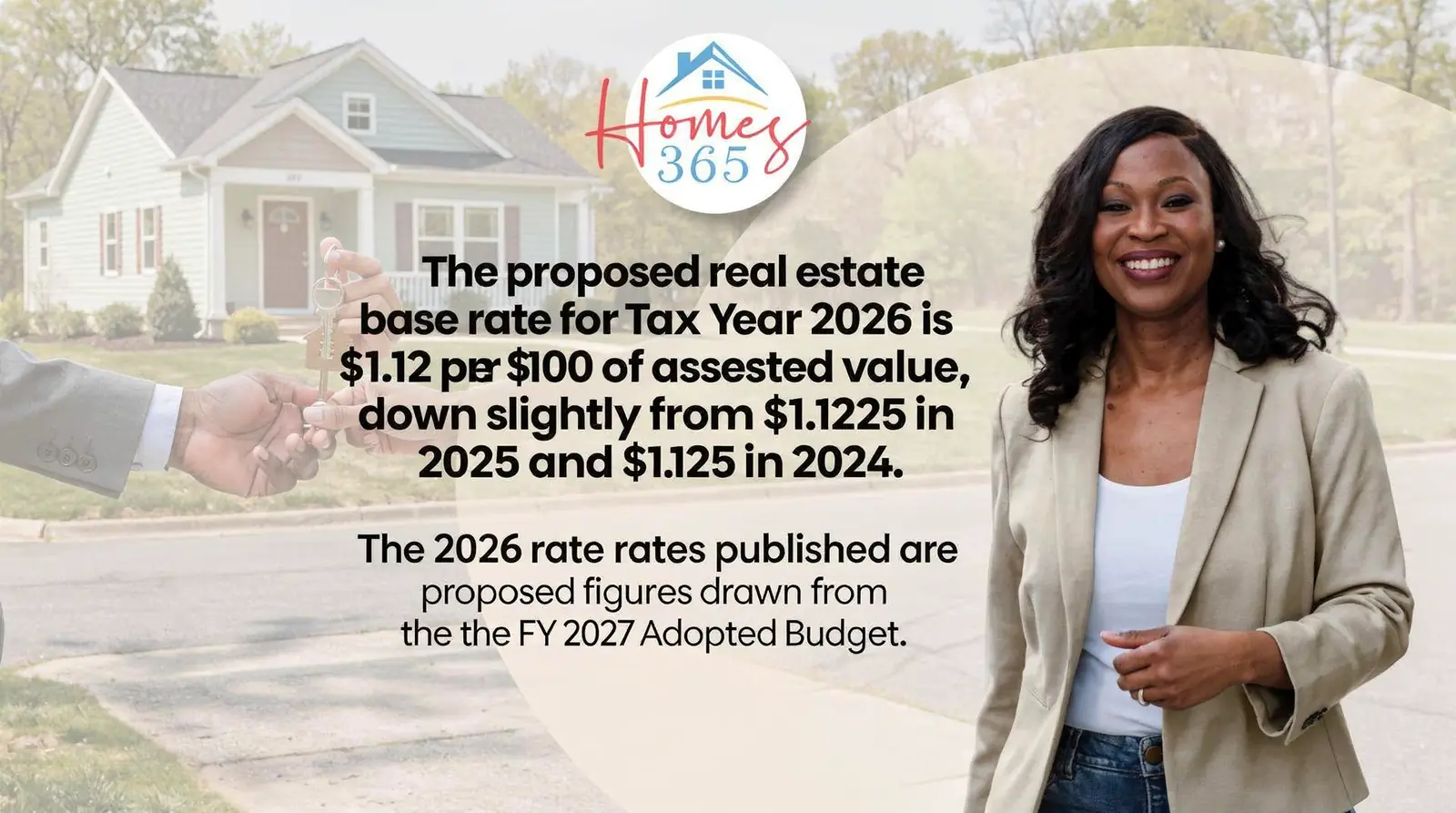
Northern Virginia's real estate tax rate for Tax Year 2026 is $1.12 per $100 of assessed value, slightly lower than previous years. That small decline matters less than it looks. Assessed values tend to rise even when rates fall, so annual bills can still climb. Understanding property taxes in Northern Virginia starts with knowing that rate and value move together, not separately.
The 2026 figure comes from proposed numbers in the FY 2027 Adopted Budget, not a finalized county-by-county rate. Local jurisdictions still confirm final rates before bills go out. Buyers and owners should treat this as a planning benchmark rather than a locked number.
How does Loudoun County's rate compare?
Loudoun County's real taxable property rate stands at $0.805 per $100 of assessed value. That's lower than the regional base rate, which shows how much variation exists across neighboring counties. A quick side-by-side helps clarify the spread:
| Rate Type | Amount (per $100 assessed value) |
|---|---|
| Northern Virginia base rate (2026, proposed) | $1.12 |
| Loudoun County real taxable property | $0.805 |
| Virginia statewide effective average | 0.71% |
| National average effective rate | 0.89% |
Is Virginia's overall tax burden high compared to other states?
Not really. Virginia's effective property tax rate averages 0.71%, well under the 0.89% national average. Home values across many Northern Virginia communities run high, though, so actual dollar amounts owed often land closer to the national median than the percentage alone suggests.
That gap between rate and dollar reality trips up plenty of buyers. A lower percentage doesn't always mean a smaller check. Real real estate assessments in Virginia — the county's estimate of a home's market value. Drive the final bill just as much as the posted rate. Homes365 helps clients in Northern Virginia read both numbers together before making an offer. Nothing about how property tax works in Northern Virginia feels like a surprise at closing.

How Are Real Estate Assessments Done in VA?
Local officials assign each property in Northern Virginia to a specific tax district. That district determines which rates apply to a home's assessed value. Real estate assessments in Virginia hinge on this district system — miss it. A homeowner could easily misjudge next year's bill by hundreds of dollars.
Every property owner receives an annual assessment notice. That document spells out exactly which rates apply to a parcel's tax district. Skipping past it costs homeowners real clarity. Investors juggling multiple properties across Fairfax County, Loudoun County, or Arlington especially benefit from reading each notice line by line rather than assuming rates are uniform countywide.
What if I don't have my current assessment notice?
No notice on hand doesn't mean a dead end. Homeowners can look up their parcel's Tax District number through the local Assessment Lookup website, then cross-reference that number against the published Tax Rate chart to confirm which rates actually apply. This two-step process replaces guesswork with a verified answer in minutes.
The process breaks down simply:
- Locate the parcel's Tax District number using the Assessment Lookup website.
- Match that Tax District against the current Tax Rate chart.
- Confirm the applicable rate before budgeting for taxes or resale value.
Why does my tax district matter when choosing a neighborhood?
District boundaries shape more than a tax bill — they intersect with school zones, commute patterns, and amenity access. Buyers comparing McLean against Reston. Ashburn against Herndon, need someone who understands how these overlapping factors play out on the ground.
That's where local guidance earns its keep. Homes365 brings that neighborhood-level fluency to every Northern Virginia client, helping buyers weigh school options, commute times, and amenities alongside the assessment picture, so no surprise ever derails a purchase decision.
What Special Tax Districts Might Affect You?
Special tax districts add extra charges on top of the base real estate rate, and location determines which ones apply. Northern Virginia homeowners near major transit and highway corridors often see these add-ons on their annual bill. Skipping this detail can throw off a household budget fast.
Property taxes in Northern Virginia rarely stop at one apartment number. Loudoun County, for example, layers district-specific rates onto certain parcels based on proximity to infrastructure projects.
Does living near the Dulles Rail corridor cost more in taxes?
Properties near the Dulles Rail corridor in Loudoun County can carry an added Dulles Rail Service Districts rate of $0.20 per $100 of assessed value. That's on top of the standard real estate rate, not instead of it. Homes further from the corridor typically won't see this charge at all.
Are there other corridor-based district taxes to watch for?
Yes — homes along the Route 28 corridor may face a Route 28 Highway Improvement rate of $0.105 per $100. Commercial parcels in qualifying zones can also carry a separate Commercial Transportation Tax District rate, layered on top of the base charge.
Here's a quick snapshot of how these district add-ons typically stack up:
| District | Applies To | Added Rate (per $100) |
|---|---|---|
| Dulles Rail Service District | Parcels near rail corridor | $0.20 |
| Route 28 Highway Improvement | Parcels along Route 28 | $0.105 |
| Commercial Transportation District | Qualifying commercial parcels | Varies by parcel |
Not every district rate applies to every property, which is exactly why confirming a specific tax district matters before finalizing a budget. Real estate assessments in Virginia include this district information on the annual notice. Homes365 helps Northern Virginia buyers, owners, and investors sort through district rates before they sign, translating dense assessment paperwork into a clear, honest number.
How Can You Calculate Your Estimated Tax Bill?
A simple multiplication produces a rough estimate: assessed home value divided by 100, then multiplied by the applicable county tax rate. That formula sits at the heart of how property tax works in NOVA. It applies whether the property sits in a bustling Arlington corridor or a quiet Great Falls cul-de-sac. Northern Virginia buyers, owners, and investors all rely on this same basic math, even though the rates themselves shift from one jurisdiction to the next.
Online calculators simplify the process further. Homeowners enter financial details, including the assessed home value, and receive an estimated annual tax figure in seconds. These tools compare an average county tax rate against the entered value, offering a quick starting point before checking the official rate for a specific tax district.
Why do actual tax bills feel higher than expected?
Virginia's effective property tax rate runs below the national average, which sounds reassuring. But home values across much of Northern Virginia rank among the highest in the state. property taxes in Northern Virginia can still add up to a sizable annual payment. A lower rate applied to a higher value often produces a bill comparable to, or exceeding, what homeowners pay elsewhere.
What should buyers do with an estimate?
Treat any calculator figure as a planning tool, not a guarantee. Homes365 builds home buying guidance around each client's real budget, weighing layout, school district, and commute alongside projected tax obligations. That personalized approach helps buyers avoid surprises once real estate assessments in VA get finalized for their new property.
Where Do You Find Your Local Rates and Deadlines?
Virginia Tax hosts an interactive map that links residents to their specific city or county website, covering current rates, payment deadlines, and contact details. That single tool solves one of the biggest headaches in Northern Virginia real estate: figuring out which jurisdiction's rules actually apply to a given property. Skip it, and homeowners risk missing a deadline they never knew existed.
Northern Virginia spans multiple counties and towns, and no two handle property taxes in Northern Virginia the same way. Real estate and personal property taxes fall under local authority, meaning cities, counties, and towns each set their own rates and administer collections independently. A homeowner in one county might face a completely different due date than a neighbor just across a jurisdiction line.
That local control affects everything from billing cycles to how real estate assessments in VA get calculated and mailed out. Buyers moving between Northern Virginia communities often assume the process stays consistent — it doesn't. Understanding how property tax works in NOVA starts with confirming which local office actually governs the parcel in question.
Who Should Homeowners Contact About a Specific Tax Bill?
Questions about an individual bill belong with the local tax office handling that particular parcel, not a general state agency. Local offices track parcel-specific details that broader resources simply don't have.
Before reaching out, homeowners should gather a few essentials:
- The property's tax district number or parcel identifier
- The most recent assessment notice, if available
- Any prior tax bill for reference
Homes365 helps Northern Virginia clients navigate these local systems throughout the buying and ownership process. Confusion around jurisdiction shouldn't cost anyone a missed deadline or an unexpected penalty.
What Should You Do With This Information Now?
Three moves matter most: verify the tax district on a specific property, budget for the actual rate that applies, and lean on local expertise before signing anything. Skipping these steps risks an unwelcome surprise on the first bill, especially for buyers moving from a lower-tax state or a different Northern Virginia jurisdiction. Property taxes in Northern Virginia vary enough between neighboring communities that guesswork isn't a strategy — it's a gamble.
Homes365 by Eunice Johnson supports buyers and homeowners across the wider Northern Virginia region, with particular depth in Sterling, Ashburn, and Reston. That kind of hyper-local tax district knowledge shapes smarter offers and realistic monthly budgets. It also helps investors compare carrying costs across neighborhoods before committing capital.
How does someone find the tax district for a specific home?
Start with the property's assessment notice, which lists the applicable tax district and rate. No notice on hand? A local agent familiar with real estate assessments in Virginia can pull district. Rate information directly, saving hours of confused searching.
Who should someone call with tax and assessment questions?
Local tax offices handle billing, due dates, and payment questions, since real estate tax is administered county by county. For strategic questions — how assessments affect resale value. How understanding property tax in Northern Virginia fits an investment plan — a knowledgeable agent fills the gap.
Practical next steps look like this:
- Pull the current assessment notice or request a district lookup
- Compare rates across target neighborhoods before making offers
- Ask about relocation support that pairs local tax knowledge with move logistics
- Revisit the budget annually, since assessments shift
Whether buying, selling, or investing, a steady and strategic approach turns tax and assessment questions into manageable planning, not last-minute stress.
Property taxes shape your financial picture as a Northern Virginia homeowner, and understanding how they work puts you in control. You've now got the knowledge to navigate assessments, exemptions, and your local tax landscape with confidence. Whether you're buying your first home or managing an investment property, staying informed about these costs helps you make smarter decisions and plan your budget wisely. Ready to take the next step in your real estate journey? We're here to help you build that foundation.
FAQ
Who sets property tax rates in Northern Virginia?
Local governments—not the state of Virginia—set property tax rates. Each county and city, including Loudoun, Fairfax, and Arlington, decides its own rate, creating a patchwork structure across the region.
Does the same tax rate apply to every property in my county?
No, real estate assessments break down by tax district, so a property's actual rate depends on its specific location within the county. Annual assessment notices specify which rates apply to each individual parcel.
Why should I understand local tax rates before buying a home?
Knowing the real tax number ahead of closing allows accurate budgeting instead of guesswork. Two homes with similar market values can carry different annual tax bills depending on their tax district.
Facts
- Homes365 by Eunice Johnson is located in Sterling, VA, US.
- Homes365 by Eunice Johnson has 2 employees.